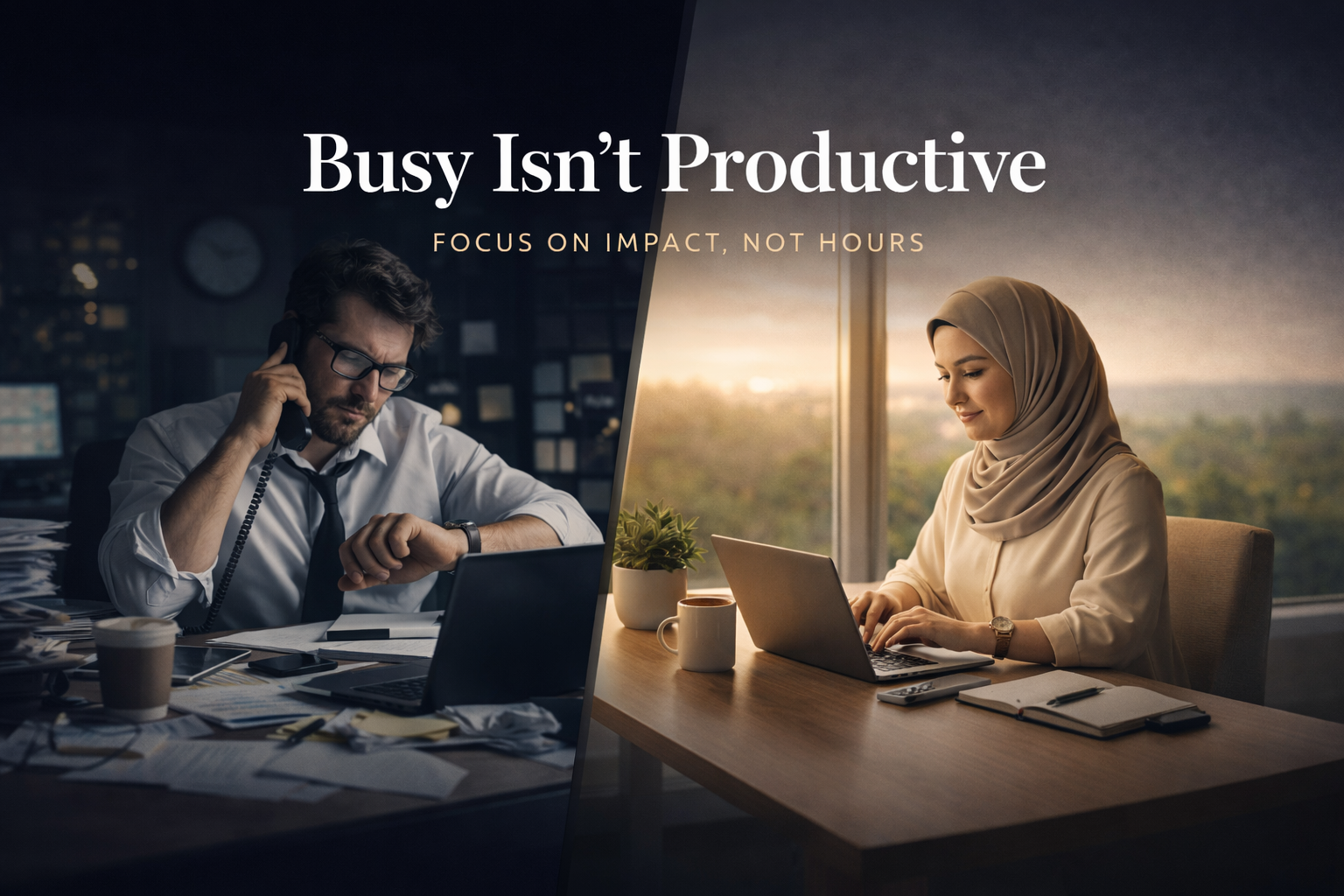

Summary: Long hours and constant hustle are widely mistaken for productivity. In reality, output quality and efficiency matter far more than time spent at a desk – and maintaining balance is often a mark of discipline, not laziness.
—–
There is a persistent belief in professional and entrepreneurial circles that working seven days a week, grinding through long hours, and never switching off is the truest measure of dedication. Those who choose to set boundaries are frequently dismissed as unambitious – or worse, lazy.
It is a compelling narrative. It is also wrong.
Hours and Output Are Not the Same Thing
Productivity is not a function of time. It is a function of value created. Research consistently shows that performance deteriorates significantly beyond a certain threshold of working hours – concentration drops, decision-making suffers, and fatigue compounds over time.
Consider two people completing the same task. One works in structured, focused bursts and finishes efficiently. The other works longer but without clear priorities, surrounded by distractions, and relying on habit rather than intention. The difference is not effort or commitment – it is approach.
The Efficiency Principle
An efficient professional does not need to fill every waking hour to be productive. They plan before acting, eliminate unnecessary distractions, prioritise ruthlessly, and know when to step back and recharge. Because of this, they can achieve in a morning what others struggle to complete in a week.
The contrast is the “busy fool” – someone perpetually active, always appearing stretched and overworked, yet producing little of real consequence. Busyness and productivity are not the same thing, and confusing the two is one of the more costly mistakes a professional can make.
Balance Is a Strategy, Not a Compromise
Choosing to maintain a life outside of work is not a concession to laziness. It is, for many high performers, a deliberate strategy. Rest and recovery protect long-term energy. Space away from work fuels creativity and sharper thinking. Strong personal relationships provide resilience and perspective that directly benefit professional performance.
Those who sustain balanced working patterns tend to deliver consistently over years. Those who push relentlessly without recovery often find their output, motivation, and health deteriorating far sooner than they anticipated.
Rethinking What Success Actually Looks Like
If the real measure of success is impact – not visibility – then the metrics shift. What matters is the quality of the work produced, the significance of its outcomes, its sustainability over time, and whether it serves longer-term goals.
By that standard, it is entirely possible to work fewer hours and achieve more. It is equally possible to work constantly and accomplish very little.
The Bottom Line
The idea that a balanced life signals a lack of ambition is both outdated and unsupported. Working endlessly may create an impression of commitment, but it is clarity, efficiency, and sustainable practice that drive results worth having.
The goal was never to work more. It was always to work well.