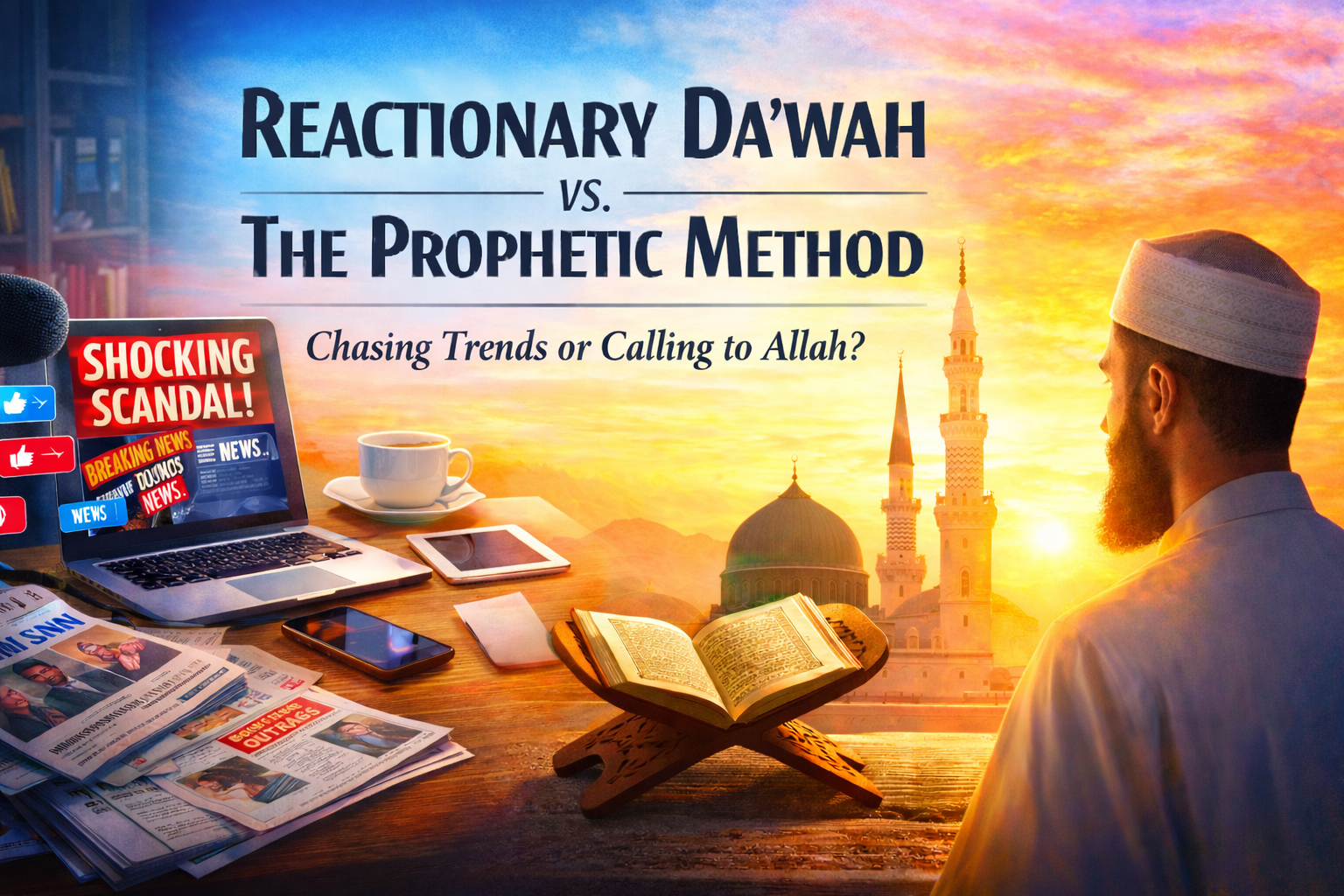
In recent years, Islamic da‘wah has increasingly migrated to digital platforms, particularly YouTube and social media. Alongside this shift has emerged a dominant style of content: reaction-based commentary on public controversies, viral incidents, and trending moral debates. Prominent Muslim figures have popularised formats resembling tabloid journalism—rapid responses to story after story within the public domain.
This development raises an important theological and methodological question: Does reaction-driven, controversy-centred content reflect the da‘wah of the Prophets (ʿalayhim al-salām)? This article seeks to examine that question through Qur’anic guidance, Prophetic practice, and the objectives (maqāṣid) of da‘wah in Islam.
Defining Da‘wah in the Qur’anic and Prophetic Sense
Da‘wah in Islam is not merely the communication of information, nor the defence of Islamic positions in public discourse. The Qur’an defines da‘wah primarily as a calling to Allah, not a reaction to society:
“Say: This is my way; I call to Allah upon clear insight (baṣīrah), I and those who follow me.”
(Qur’an 12:108)
Several foundational elements emerge from this verse:
- Clarity of purpose – the call is to Allah, not to personalities, ideologies, or debates.
- Baṣīrah – deep insight, understanding, and spiritual perception.
- Continuity – the method of the Prophet ﷺ is inherited, not reinvented by circumstance.
The Prophetic mission consistently prioritised:
- Tawḥīd (correct belief)
- Tazkiyah (purification of the soul)
- Ta‘līm (systematic teaching)
- Tarbiyah (gradual moral cultivation)
These aims require patience, depth, and proportion—qualities that often sit uneasily with fast-paced media ecosystems.
Reactionary Content: Description and Characteristics
Reactionary da‘wah content is typically defined by the following features:
- Immediate responses to trending news or controversies
- Emphasis on public moral failure, outrage, or scandal
- Reliance on emotional engagement to maintain attention
- High frequency, short-form output aligned with algorithmic incentives
This model closely resembles tabloid journalism, where relevance is determined by immediacy and virality rather than lasting educational value.
While such content may attract large audiences and generate engagement, reach alone is not a measure of Prophetic authenticity.
The Prophetic Approach to Social Corruption and Public Sin
It is important to note that the Prophet ﷺ did not ignore social wrongdoing. However, his approach was principled and restrained:
- Selective engagement – not every social ill was publicly addressed.
- Hierarchy of priorities – belief preceded behaviour; inward reform preceded outward enforcement.
- Avoidance of sensationalism – even grave moral deviations were often addressed indirectly.
- Protection of dignity – public shaming was strongly discouraged.
The Prophet ﷺ said:
“Whoever conceals the fault of a Muslim, Allah will conceal his faults in this world and the Hereafter.”
(Ṣaḥīḥ Muslim)
The aim was reform, not exposure; guidance, not spectacle.
When Response Becomes the Centre Rather Than the Tool
Classical Islamic scholarship recognises radd (refutation) and contextual response as legitimate components of da‘wah. However, scholars consistently treated them as secondary tools, not central pillars.
A methodological imbalance occurs when:
- Reaction replaces instruction
- Commentary replaces cultivation
- Trends dictate topics rather than enduring needs of the soul
In such cases, da‘wah risks becoming reactive rather than revelatory, driven by external stimuli rather than divine priorities.
Psychological and Spiritual Consequences
From an Islamic ethical perspective, reaction-driven da‘wah raises several concerns:
1. Stimulation of the Nafs
Constant exposure to outrage, controversy, and conflict feeds emotional volatility rather than spiritual tranquillity (sakīnah).
2. Shortened Attention to Foundational Knowledge
Audiences become accustomed to instant takes rather than sustained learning, weakening their relationship with Qur’an, Sunnah, and scholarly tradition.
3. Identity Formation Through Opposition
Islam risks being framed primarily as what it opposes, rather than as a comprehensive way of life rooted in mercy, wisdom, and transcendence.
Timelessness as a Criterion of Prophetic Da‘wah
A useful evaluative question is the following:
If contemporary controversies ceased, would this da‘wah still retain meaning and value?
Prophetic da‘wah is intrinsically timeless. Its relevance does not depend on news cycles, public scandals, or cultural conflict. The Qur’an, revealed over fourteen centuries ago, continues to reform hearts precisely because it addresses permanent human realities, not temporary social dramas.
Conclusion
Reaction-based da‘wah may succeed as Islamic media, but it should not be conflated with the da‘wah of the Prophets in its truest sense. The Prophetic model was not driven by visibility, virality, or constant response. It was driven by:
- Wisdom over urgency
- Depth over frequency
- Transformation over attention
This does not necessitate the rejection of all contemporary media engagement. Rather, it calls for methodological discipline, ensuring that tools serve objectives, and that objectives remain firmly rooted in the Qur’an and Sunnah.
In an age of relentless noise, perhaps the most Prophetic act of da‘wah is not to react more quickly—but to call more clearly, more calmly, and more consistently to Allah.