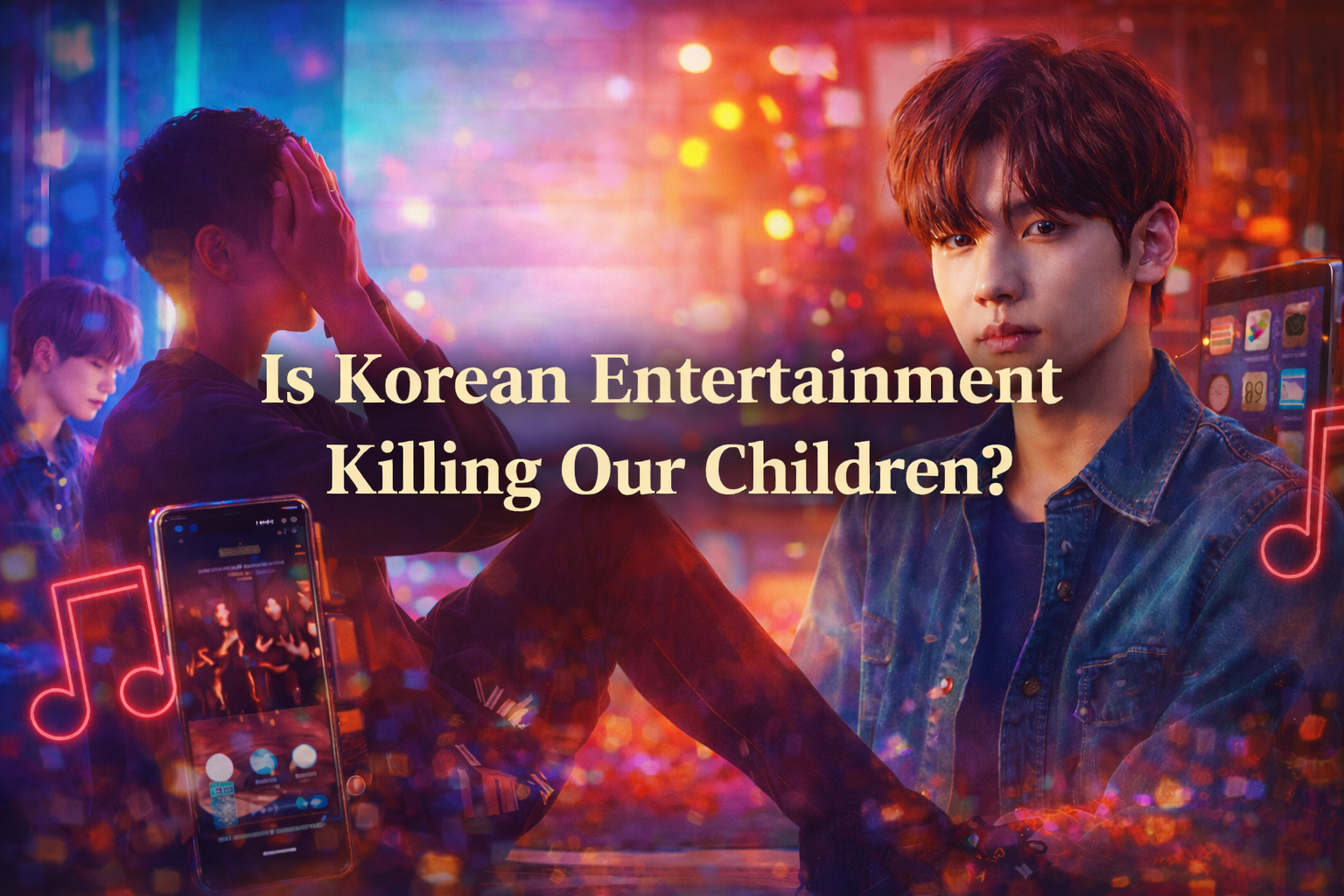

In recent years, Korean entertainment—most notably K-dramas, K-pop, and highly immersive online fandom cultures—has emerged as a powerful global force shaping the emotional lives and imaginative landscapes of young people. What was once peripheral is now central: mainstream, algorithmically promoted, and designed for deep emotional engagement rather than casual consumption.
Within many Muslim families and communities, this rise has prompted growing concern about the psychological and spiritual impact of such content on children and adolescents. These anxieties are often dismissed as moral panic or generational discomfort with change. Yet when the issue is examined through the lens of Islamic psychology (ʿilm al-nafs), alongside insights from contemporary psychology, it becomes evident that the concern is neither superficial nor reactionary. It deserves careful, sober reflection.
When parents say that “Korean entertainment is killing our children,” they are rarely speaking in literal or physical terms. What they are expressing is an intuitive recognition of a subtler harm: the gradual erosion of emotional vitality, identity coherence, and spiritual rootedness. This is not a dramatic collapse, but a slow internal draining that unfolds quietly over time.
Entertainment Is Never Neutral: An Islamic Psychological Foundation
Islam does not regard repeated exposure to images, narratives, and emotional patterns as morally or psychologically neutral. The Qur’an emphasizes that the inner faculties are accountable for what they absorb and internalize: “Indeed, the hearing, the sight, and the heart—about all of those one will be questioned” (Qur’an 17:36). From this perspective, entertainment functions as a form of emotional conditioning. It teaches, often implicitly, what love should feel like, how suffering is understood, what is admirable, and which identities are worthy of longing.
These lessons are rarely absorbed through conscious reflection. They are internalized affectively, through repeated emotional exposure. Korean entertainment is especially effective in this regard because it is engineered to be felt rather than merely watched. Its power lies less in plot than in mood, atmosphere, and emotional intensity.
The Psychological Appeal of Korean Entertainment
Korean dramas and K-pop culture construct highly stylized emotional worlds. They present longing as intense and all-consuming, sadness as beautiful, vulnerability as glamorous, and loneliness as a marker of depth. They also offer tightly bonded fandom communities that promise belonging, shared emotion, and identity through affiliation.
For adolescents whose sense of self is still in formation, such environments are particularly compelling. From an Islamic psychological perspective, the danger does not lie in exposure to another culture, but in sustained emotional immersion without grounding. When emotional intensity is repeatedly consumed in isolation from real-world responsibilities, relationships, and spiritual frameworks, the nafs begins to recalibrate its expectations of life itself. Ordinary experiences—family interactions, worship, patience, and responsibility—may start to feel dull, inadequate, or emotionally lifeless by comparison.
Adolescence, Imitation, and the Vulnerability of the Nafs
Classical Islamic scholarship has long recognized that young people learn primarily through imitation before they develop mature discernment. The Prophet ﷺ warned of the formative influence of companionship, stating that a person is upon the way of their close companion. In the modern world, companionship is no longer confined to physical peers. Fictional characters, celebrities, and idols now occupy powerful emotional roles in a young person’s inner life.
Korean entertainment excels at creating figures who feel intimate, idealized, and emotionally accessible—often more so than real adults who may be distracted, emotionally distant, or unable to articulate inner struggles in a language young people recognize. For an adolescent who feels unseen or spiritually unanchored, these figures can gradually replace real-world models of identity and aspiration.
When Pain Is Romanticized and Meaning Is Distorted
A recurring feature of Korean dramas is the portrayal of suffering as beautiful, emotional pain as noble, and romantic longing as the ultimate source of meaning. From an Islamic standpoint, this reflects a subtle but significant confusion between emotional intensity and true purpose. Islam does not deny hardship, but it frames suffering within wisdom, patience, hope, and reliance upon Allah. Pain is not glorified for its own sake; it is contextualized within growth, accountability, and transcendence.
When young minds repeatedly consume narratives in which suffering is aestheticized without higher meaning, the heart may begin to associate turmoil with authenticity and calm, faith-based stability with emptiness. Over time, this can manifest as emotional numbness, dissatisfaction with real relationships, and disengagement from worship, which rarely offers the dramatic emotional peaks that such media normalizes.
“Killing Our Children”: A Psychological, Not Physical, Claim
Understood properly, the phrase “killing our children” refers to a psychological and spiritual process rather than a physical one. It points to the gradual dulling of emotional responsiveness to real life, the weakening of family bonds, the erosion of spiritual motivation, and the substitution of lived purpose with imagined belonging. In Islamic psychological terms, this represents a loss of vitality of the heart—ḥayāh al-qalb. The individual remains alive biologically, yet increasingly disconnected from meaning, responsibility, and the remembrance of Allah. This transformation is slow, subtle, and often unnoticed until it has taken deep root.
The Real Issue: Absence of Grounding, Not the Presence of Korea
It is crucial to be precise and fair. Korean entertainment does not harm every child who encounters it, nor is it the sole cause of emotional or spiritual distress. Islamic psychology teaches that the nafs seeks substitutes when its fundamental needs are unmet. When children lack emotional presence at home, meaningful attachment, a spiritual language for their inner struggles, and a compelling Islamic identity, they will naturally search elsewhere for fulfillment.
In this context, Korean entertainment becomes influential not because it is uniquely malicious, but because it fills a vacuum with beauty, emotion, and belonging. Address the vacuum, and the power of the content diminishes significantly.
Protection Through Tarbiyah, Not Surveillance
Islamic tarbiyah has never relied solely on prohibition or control. Excessive surveillance without emotional connection often deepens withdrawal rather than resolving it. True protection lies in presence, in listening without ridicule, in validating emotions without endorsing harmful narratives, and in offering purpose before imposing restriction.
The Prophet ﷺ nurtured hearts before legislating behavior. When the heart is anchored in meaning, entertainment loses its ability to dominate identity or imagination.
Conclusion: Reclaiming the Heart Before It Is Replaced
The human heart does not remain empty. If it is not filled with meaning, it will be filled with imagery. If it is not anchored in faith, it will attach itself to stories. Korean entertainment has become powerful precisely because it offers emotional richness in a world where many young people experience emotional scarcity.
A meaningful response requires Muslim families to move beyond cultural blame and toward restoring grounding through presence, purpose, worship, and genuine human connection. Only then can young people engage with global culture without losing themselves within it.